
Bonn Wissenschaftsnacht, May 21–22, 2026 in Bonn city center: iBehave will be taking part in this public science event, featuring interactive activities and presentations from 09:00–18:00 on May 21 and 09:00–23:00 on May 22.
How can muscle signals control a computer game? How does artificial intelligence analyze human movement? And how do researchers transform raw biological signals into meaningful scientific insights?
At the Wissenschaftsnacht 2026 in Bonn, the iBehave Network invites visitors to explore these questions firsthand at our interactive tent. Across three engaging stations – CADRE, iBOTS, and Team Cerebellum – we will showcase how modern neuroscience combines physiology, computational modeling, and artificial intelligence to better understand the human body and brain.
CADRE – From Physiological Signals to Scientific Insight
The CADRE team will present live demonstrations of neuroscience data collection tools used in behavioral and physiological research. Visitors will see how signals such as heart rate and other physiological measurements are recorded, processed, and interpreted. The exhibit highlights how complex biological data are transformed into meaningful results that help researchers understand human behavior and brain function.
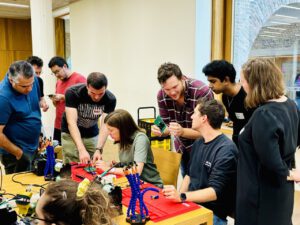
Image: Practical demonstration by the CADRE team led by Trace Robbins showcasing the construction and testing of a setup for recording physiological signals, such as heart rate.
iBOTS – Control a Game with Your Muscles
At the iBOTS station, visitors can actively participate in an interactive EMG-based demonstration. EMG (electromyography) measures muscle activity, and in this setup, participants will be able to control a digital application using their own muscle signals. This hands-on activity illustrates how biological signals can be captured, computationally processed, and translated into real-time outputs, demonstrating the powerful connection between biology and technology.
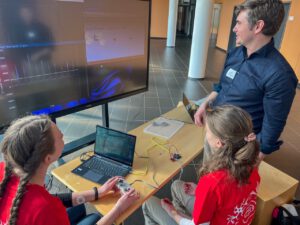
Image: Dr. Nicholas Del Grosso, head of the iBOTS platform, represents the iBehave network at DNO 2025, the neuroscience Olympiad for students, showcasing an interactive EMG-based demonstration game that allows participants to control a digital application using their own muscle signals.
Team Cerebellum – AI-Based Motion Capture in Research
The “Team Cerebellum,” led by Philipp Wegner, will present AI-driven motion capture technology. Using cameras and computational models, movements can be digitally recorded and analyzed in real time. Visitors will be able to see an AI-based representation of their own movements and learn how this technology is applied in research on movement disorders such as ataxia. By analyzing motion data, researchers gain valuable insights into how neurological conditions affect coordination and motor control.
 .
. 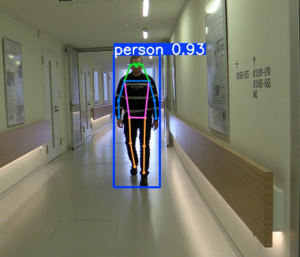
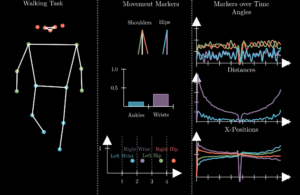
Image left: This figure shows how we study a person’s walking. On the left, a skeleton is created with 17 key body points. The middle shows measurements like joint angles and distances between body parts. On the right, these measurements are tracked over time to show how the body moves.
Image Right: This shows a person walking back and forth, with a skeleton overlaid to track their movements. The box around them shows where they are in the image.
Through these interactive demonstrations, the iBehave Network offers a unique opportunity to experience neuroscience beyond the laboratory. Visitors will discover how cutting-edge research integrates biology, engineering, and artificial intelligence and how these approaches contribute to advancing our understanding of the brain and human behavior.
We look forward to welcoming you to our tent at Wissenschaftsnacht 2026!